UPCOMING:
4LIYC Meeting: November 2026
4LIYC Shipstore: Order custom iceboat shirts, hats, and gear. More information.
BURGEE: Order your 4LIYC Burgee
Pay Your Dues Online
Remembering Rick as the Fleet Heads North

Rick Hennig and crew on the podium in 2017.
TRACK THE FLEET: LINK
The start of the Chicago Yacht Club Race to Mackinac feels like the halfway point of the off-season until ice sailing season begins. Here’s the annual look through the fleet to see which iceboaters are making the trip north.
This year, though, there’s one familiar name missing. Rick Hennig was a longtime Mackinac sailor, and his absence will be felt both on Lake Michigan and in the iceboating community. As the fleet sets out today, many of us will be thinking of Rick.
Iceboaters racing to Mackinac this year include:
USUAL SUSPECTS
DN champion Ron Sherry
CALLISTO
Co-skipper Steve Orelebeke and crew member Jay Yaeso, both longtime Skeeter sailors
LEGACY
DN sailors Ben Witman and Dave Elsmo, along with Mendota Yacht Club sailor Matt Baron
KASHMIR
DN sailor hailing from the Toledo Ice Yacht Club Jody Kjoller
Best of luck to everyone headed north. Have a safe race, and we’ll be following along from shore.
July 4th Goes Ice Boating

Ice Riders on the Chesapeake Bay by Charles Wysocki
Here’s our collection of July 4th ice sailing photos, another opportunity to remember that two of the founders, Ben Franklin and John Adams thought about iceboating. Ben even ordered a set of plans! But one ride in the Netherlands was quite enough for John Adams. He wrote to a friend, that iceboating “as again endangered my Health and my Life.” Enjoy the holiday and Think Ice!
When Ben Franklin Ordered Iceboat Plans
Ben Franklin’s Iceboat Drawings
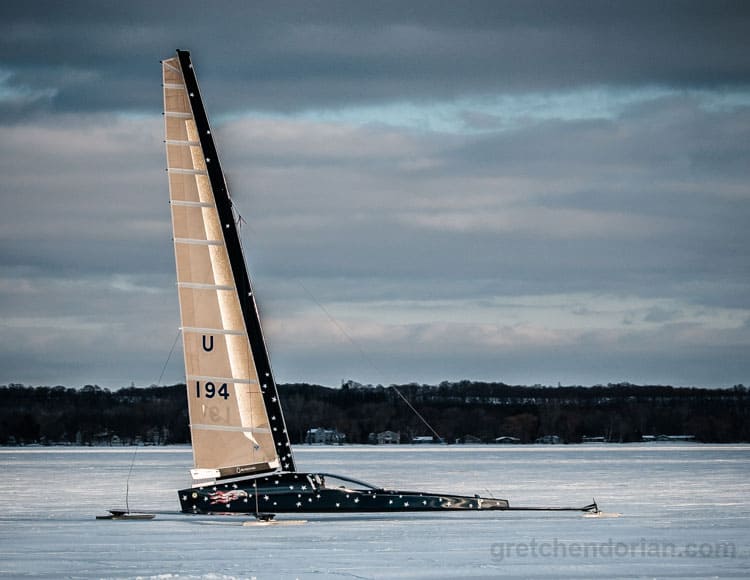
JD’s EAGLE, Class A Skeeter. Photo: Gretchen Dorian
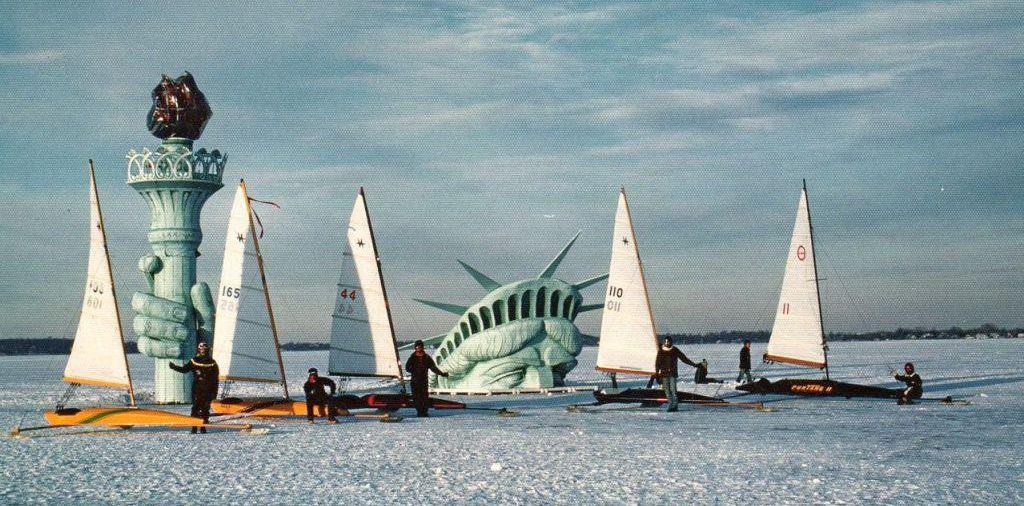
Shown here from left to right doing their best to make the ordinary extraordinary are: Don Ermer, Don Sanford, Steve Arnold, Lady Liberty, Ty Reed and Ken Kreider.
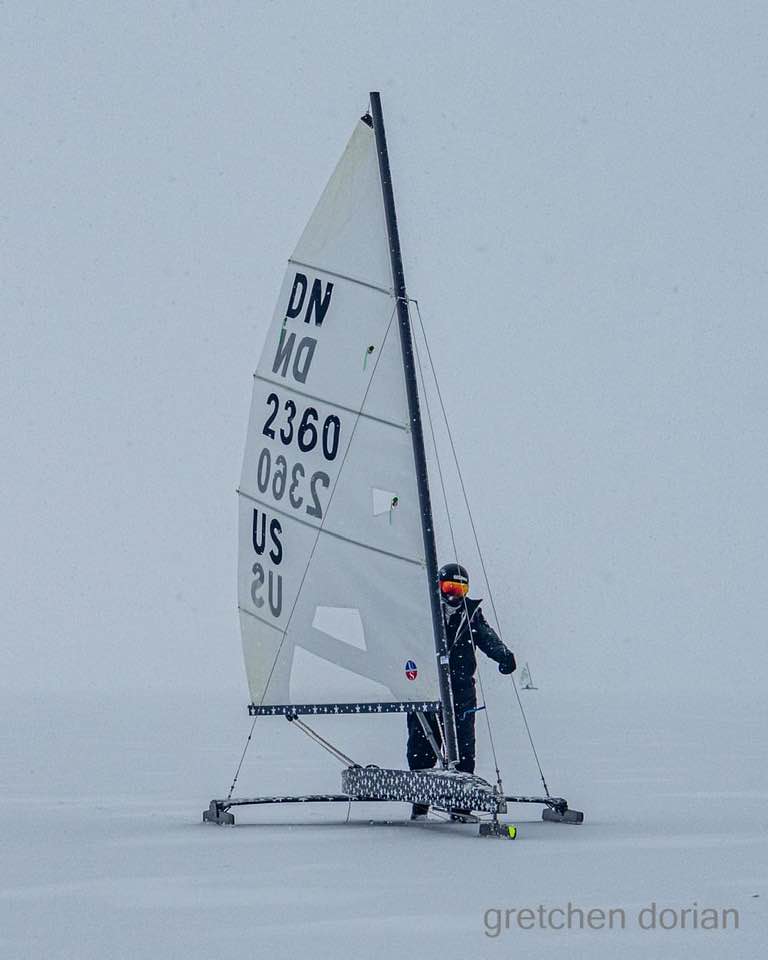
Patriotic Pete Johns
Hotter than July: Skeeter Fleet News

Hot news from the Skeeter fleet!
Paul Krueger’s legendary Skeeter RAMBL’N has a new owner, but one thing isn’t changing. The boat will continue to sail under the name RAMBL’N.
Lake Geneva’s Kyle Navin has purchased the boat. Kyle has an impressive sailing résumé, representing American Magic in the Youth America’s Cup, winning the 2025 E Scow National Championship, and finishing second at the 2026 Nite Nationals. He also represents another accomplished sailor making the jump into Skeeters. Last season, multi-time DN World Champion Matt Struble purchased Tom Hyslop’s Skeeter. Those additions can only make an already competitive fleet even stronger.
RAMBL’N won’t be sitting in the trailer very often. When Kyle is away competing in one of his many sailing campaigns, his father, Dave Navin, will take the helm. Dave comes into the Skeeter fleet fresh off his victory at the 2026 Nite National Championship, with Kyle finishing second.
Paul Krueger campaigned his many RAMBL’N Skeeters since the late 1950s, making it one of the best-known Skeeters in the fleet. It’s good for iceboating to see the boat staying in the hands of a family that will continue to race it hard while preserving its identity.
Eight Bells for a Legend: Jane Pegel US805
UPDATE: Funeral Information
Date: Friday, June 26
Visitation: 9 AM – 11 AM
Service: 11 AM
Location: Delavan United Methodist Church 213 S. 2nd Street, Delavan, WI. LINK TO MAP
Memorials in Janes name may be directed to Geneva Lake Sailing School LINK or Green Lake Area Animal Shelter.
Arrangements made by Toynton Funeral Home, 328 Kenosha Street, Walworth, WI (262) 275-2171.
Susie requests that if you attend the funeral, please wear your sailing apparel.
Jane Pegel Archives
Via Susie Pegel
Jane Pegel died this morning, June 6, 2026, at the age of 92. Jane began her iceboating career sailing a Skeeter I-169 named “Holy Smoke.” Around 1956 she made the transition to DNs, first racing with number 305 and later 805. She was DN class champion in 1961 and 1963 and served as DN technical committee chairperson for decades. She was in the group that founded the National Iceboat Authority that formulated right-of-way rules for iceboats. Jane met her husband Bob Pegel while iceboating. Jane is survived by daughter Susie Pegel (formerly DN 905) and grand-cat Sweet Pea who was adopted from the animal shelter in Green Lake in 2020.
Many of today’s sailors may not realize how much of the sport they enjoy was shaped by Jane’s work and dedication. She was a competitor, an organizer, a rule maker, and a trailblazer whose influence extended far beyond her own racing career.
Our thoughts are with her daughter, Susie Pegel, family, and friends. Susie reports that a funeral service is being arranged, likely for later in June.
Fair winds, Jane.
Jungo Land Sailing Adventure: Ron Sherry Takes the Win

RESULTS
The photos tell the story. This looks like one of those events people will regret missing, with a lot of “you had to be there” stories coming out of Jungo Yacht Club.
After three days of racing in a variety of wind conditions, 5-time DN World Champion and 14-time DN North American Champion Ron Sherry claimed victory in the A Fleet with 12 points. Daniel Hearn, who invited Ron and Leon Lebeau to Nevada and supplied the boats they sailed, finished second with 16 points. Not bad for Ron’s first attempt at land sailing and his transition from ice to dirt was clearly successful.
When Daniel called and suggested the trip, Ron didn’t need much convincing. “Leon and I have been wanting to try that forever,” Ron recalled.
Daniel arrived with a trailer full of land yachts. Scott Dale provided the venue, having purchased the property and developed Jungo Yacht Club into one of the premier land sailing destinations in North America. During the day, sailors raced. At night, everyone gathered around campfires, shared meals, and traded stories.
Forty-six boats competed, divided evenly between A and B Fleets, with 23 boats in each fleet. In B Fleet, Reed Lorimer took top honors. The Mini-Max team competition, which paired one A Fleet sailor with one B Fleet sailor, added another dimension to the regatta. Augie Dale and Reed Lorimer captured the team title, while Ron Sherry and Leon Lebeau finished second.
One of the highlights came Saturday evening during a night sail under the full moon. Sailors raced a relay course using giant glow sticks as marks, creating the kind of scene that sounds almost too good to be true until you see the photographs.
Congratulations to Scott Dale and the Jungo Yacht Club crew for creating what appears to have been an unforgettable event.
Something tells me a few ice sailors just added Jungo Yacht Club to their bucket list. For Daniel Hearn and several others, the adventure began months ago in Damien Luyet’s shop, where the gang has been logging long hours building a fleet of Mini Skeeters in preparation for this event. Kudos to Daniel Hearn for putting people in boats, no matter what the surface!


Jungo Land Sailing Adventure: Dry-Water Racing Day 1

Jungo sunset. Photo: Tim Bellard
Sherry Opens with Three Bullets at the Mini-Max Regatta
Results
Yesterday, Friday, May 29, was the first day of racing at Jungo Yacht Club near Winnemucca, Nevada.
After rain flooded the playa earlier in the week, conditions improved quickly as expected. The water disappeared, the surface dried, and sailors were able to get in some training on Thursday afternoon before racing began on Friday.
Last night, Leon Lebeau called in with a report from the playa.
The wind was blowing around 30 mph, and you can hear it in the videos. Speeds were impressive. Leon reported that Daniel Hearn recorded a run of 60 knots. (i’ll post a short video in the 4LIYC Facebook group.)
Leon and Ron Sherry were both highly complimentary of Jungo Yacht Club, the land sailing facility created by Scott Dale. Iceboaters will recognize the family name. Scott’s father is Bill Dale of Pewaukee, Wisconsin, a longtime Skeeter sailor.
The fleet self-selected into A and B divisions. In addition to the individual competition, sailors are also competing in a team event. Each team consists of one A Fleet sailor paired with one B Fleet sailor, with their combined scores determining the team standings. Leon is competing in B Fleet while Ron is sailing in A Fleet. Leon said the format adds another layer of fun to the regatta and keeps sailors engaged throughout the fleet. (Ron and Leon are hot-bunking a Mini-Skeeter, provided by Daniel Hearn.)
While Leon was on the phone, Ron stepped into the motorhome, giving me a chance to ask how land sailing compares to iceboating.
“The vibration,” Ron said. The constant vibration as the tires roll over the playa surface was one of the biggest differences to get used to.
Whatever the adjustment, it didn’t seem to slow him down. Ron opened the regatta with three bullets in the A fleet and leads the standings after the first day. Daniel Hearn stands in second place. Reed Lorimer is in first in the B fleet.
One thing noticeable in the photos is that everyone is wrapped up in jackets. Winnemucca sits in Nevada’s high desert, and temperatures can be surprisingly cool, especially once the sun begins to drop behind the mountains.
Leon also spoke highly of the sense of community that land sailing creates. Unlike many racing venues, everyone is essentially living together out on the playa. Campfires, shared meals, stories, and bench racing become a big part of the experience.
Last night, the sailors gathered for a group dinner before preparing for another day on the desert.


Jungo Land Sailing Adventure: Waiting in Winnemucca

NOT ICE!
Some people just can’t get enough of what iceboating brings.
The waiting for weather to cooperate. The endless discussions about runners (tires in this case), alignment, wood, ice (dirt), and speed. The camaraderie that comes from chasing conditions with friends who understand why any of this matters in the first place.
Several ice sailors, including 4liyc Renegader Damien Luyet, 4liyc sails-one-of-everything Daniel Hearn, DN Champ Ron Sherry, DN and Skeeter sailor Leon Lebeau, DNers Pete Johns, Ken Smith, Tim Ballard, and long time Montana dirt and ice sailors John and Scott Eisenlohr, and likely others I’ve missed, arrived near Winnemucca, Nevada yesterday for land sailing at the Jungo Yacht Club playa.
But Mother Nature had other ideas.
Rain turned the playa into an actual lake and served as a reminder that a dry lake bed is still a lake when enough water shows up. Photos from the scene looked more like an iceboat regatta venue than a land sailing site.
The good news is that desert conditions usually work fast. If the weather cooperates, the standing water should dry quickly and could leave behind the dirt equivalent of Hollywood ice. Maybe “Hollywood dirt.”
Sailors spent the lay day camped out in motorhomes, swapping stories and waiting for the playa to come back to life. Reports this morning suggest they’ve now found a way into camp and may be racing soon.
Hopefully we’ll be getting more reports from the gang out west as the playa dries and the wheels finally start turning.

First Rule: Find breakfast
The Mattison Archives: Loading Day

Last year, Mauretta Mattison generously donated the Mattison photo archives to the Four Lakes Ice Yacht Club. Well, technically to me, because somehow I’ve become the person people send these things to. I’m glad to have them gathered in one place.
Given that Bill and Mauretta owned Star Photo and spent years in the photo developing business, the archive is extensive. Bill and Mauretta photographed everything, and we’re fortunate they did. There are boxes upon boxes of prints, negatives, and snapshots of iceboating life. It’s time to start digging through them and sharing some of the more interesting finds.
The first photo that caught my eye features another kind of classic American engineering: heavy Detroit iron. Back when cars like this early 1950s Ford hardtop, likely equipped with Ford’s Flathead V8, ruled the roads and hauled iceboats to the lake without complaint.
I believe this photo was taken at John “Pop” Bluell’s house near Yahara Place, though Jerry Simon will probably correct me if I’m wrong.
Fortunately, either Bill or Mauretta labeled the photograph. From left to right: John Bluell Jr. “Johnny,” John Bluell Sr. “Pop,” Herb Krogman “Herbie,” Dave Rosten (my father), and Bill Mattison.
You can almost reconstruct the scene, one still played out today, though the trailer may now be enclosed. The gang gathers at Pop Bluell’s house on a cold morning, loading hulls, spars, and runners onto the trailer and roof rack before heading off either to a regatta or simply out onto Mendota.
This photo is another reminder of how ordinary iceboating once was, and still is, around Madison.

The Community Rick Built
54′ of Fast: Link to Video

Rick Hennig’s nephew, Dave Elsmo, shares his thoughts about Rick below. Rick’s investment in Dave paid dividends. Dave has gone on to give countless of University of Wisconsin students their first iceboat rides and has brought many new sailors into the DN fleet.
Dave is also the videographer behind the video above, 54′ of Fast. When people ask me about iceboating, this is one of the first videos I show them. I’ve shared it countless times over the years.
Following Dave’s words, fellow stern-steerer sailor Dave Lallier, who understands what it takes to care for one of these historic boats, shares his thoughts about his friend Rick.
The Roots Rick Planted
Dave Elsmo
As the Greek proverb goes, “A society grows great when old men plant trees whose shade they know they shall never sit in.” In my moments of reflection over the past few days since Rick’s passing, this thought has kept coming back to me. I think it describes the man very well in all of his pursuits.Whether it was the soft-water programs, his cars, his iceboating, or his local community, Rick was always doing something that would inevitably benefit people he may never meet or live long enough to see impacted by his generosity. It didn’t matter. I’m not even sure that thought ever crossed his mind. He never seemed particularly interested in gaudy announcements proclaiming his involvement. If something needed doing or somebody needed help, he stepped in with his time and resources. The best of those resources was always the people he surrounded himself with. The Cabbage Patch crew was never far behind.
I remember coming back from college broke and lacking much motivation. Rick put me to work fairing the hull, plank, and mast of the DEUCE. Anybody looking at the boat would have said it was already perfect, but for days on end he kept coming back to me and another kid working with me, telling us to keep going. We were there until the boat was perfect — his version of perfect.
At the time, I knew nothing about iceboating, and I had no idea how profound the piece of equipment I was working on really was. I just knew the work was mind-numbing. While I piddled away with putty and sandpaper, Rick and a group of friends were building a wheelchair ramp for a friend’s family member. I didn’t fully digest it then, but he was doing it simply because it was the right thing to do and because someone he cared about had a need. It really was that simple and my job was to do the mind numbing stuff so he could do more important stuff.
I didn’t have much of a relationship with Rick in my younger years. I sailed casually around the local club and saw him here and there at family events. Then, out of the blue during the winter of my sophomore year at Minnesota, Rick called and told me he had picked up an iceboat from a friend and wanted me to have it and start racing. I knew absolutely nothing about the sport, but winters in Minneapolis were boring, so I picked it up one random weekend and waited for ice. A local friend from scow racing, Jim McDonagh, was an avid DN racer who told me about an event outside the Cities and said to just show up. I had no idea what I was doing. I had the boat, one wrench, and some fuel in the tank. I hit the ice, caught a puff, ripped off into a snow squall following Jim to the course, and never looked back.
The next summer, Rick told me to show up at a swap meet in Lake Geneva, so I made the trip. He had picked up a trailer from the Pegels, a mast and set of runners from Ron Sherry, and a new sail. His thinking was that with the trailer I could get more people onto the ice and that’s exactly what happened.
I scratched around for loaner boats and soon had four programs going to get others involved in the sport. Having travel partners made it financially possible for me to keep traveling, but more importantly, it helped grow the fleet.
As I fell deeper into the sport, Rick already had another plan. There was still a massive pile of Sitka spruce sitting in his shop from the DEUCE build, so he and the Cabbage Patch crew pumped out eight or ten sets of DN sideboards and started building. They got one hull started, which I picked up along with the rest of the sideboards, and I haven’t stopped building since.
I still laugh at the idea that the scraps from the DEUCE build were enough to create an entire flotilla of DNs. Today, every set of those boards is still in the fleet and racing. Young sailors who started in those loaner boats eventually built their first hulls from some of the best wood imaginable, all sharing the same genealogy as the DEUCE.
Many of the people who started iceboating and building with that wood eventually found their way onto Rick’s summer programs. Most of them are still racing together today because he took a chance on younger people. He brought the opportunities; we brought the bodies to sail boats that always seemed to get bigger and more terrifying to manage.
That brings me back to the DEUCE.
That boat is one hell of a program. When it leaves the shed, an army of people moves across the country to make sure there are enough hands to rig, enough bodies to rotate in for racing, and enough old-timers in the pits to keep everything safe, or at least as safe as it could be. Rick took care of all of them. He spent more time making sure everybody had what they needed than sailing. I had only taken a ride on the boat twice before Rick told me to take the tiller. I’m lucky I was wearing brown coveralls that day. Despite my concerns, a few of us from the Cabbage Patch crew went out for a spin. To this day, my hands still get sweaty thinking about that ride.
The men who (re)built these A-Class stern steerers were a different breed. They are unlike anything I see coming down the pipeline anytime soon. They are unreasonable, unruly, unpredictable, unnecessary, unwavering and at this point, I’m not sure whether I’m talking about the man or the boats now
Great men are compelled to do great things, especially when they are determined to preserve history while fostering new generations. Rebuilding the boat was a community event and sailing the boat is a community event. The boat was only the mechanism, community was the point all along.
This story is just one of hundreds that will emerge over the coming weeks as people find moments to reflect on a life well lived. Mine is only a small piece of a much larger story others may never know. I would challenge others to take a moment to write or reflect on their own experiences with Rick.
The thing about planting trees whose shade you’ll never sit in is that you never know where those roots reached. Rick likely never realized how many people he set in motion, how many friendships, programs, boats, and traditions grew from the opportunities he created. But that’s the mark of a great man. He planted anyway.
By Dave Elsmo


We Are All Just Caretakers
By Dave Lallier
I first met Rick when he brought the DEUCE to Lake Winnebago near my house. It must have been shortly after he acquired her, as he was still using cotton sails. I was fortunate to have had some great sails on her with Rick.At about the same time, my brother Jeff and I were in the middle of restoring the FLYING DUTCHMEN. Rick took great interest in the restoration, as he was doing the same with the DEUCE. We had many discussions regarding the work being done. Rick was aware that we would need a new runner plank and offered to help.
After the new backbone for the DEUCE was completed, he suggested that a new plank be built at his shop. My brother Jeff was working in Milwaukee at the time, so he traveled to Rick’s every evening to work on it. Rick had all the designs and methods in place, as well as the tools and wood for the job. As you can see today, the plank is a true work of art.
After the plank was done, I asked Rick where we should go to have new stays for the mast made. He told me to assemble the boat in our yard and that he would come help. He showed up with a large hydraulic swaging machine and a bunch of cable. That afternoon, the DUTCHMEN’s mast stood again with all new stays and adjuster tubes that Rick made.
I asked him where he got all that stainless cable. He smirked and said, “Watch the evening news because there may be some sailboat masts falling over in Racine.” We had a good chuckle.
If it hadn’t been for Rick, I’m not sure the DUTCHMEN would be sailing today. It takes special people to keep these large historic yachts sailing. It has been said many times that nobody really owns these boats; we are all just caretakers of them.
Rick called me in February 2025. I was sitting in my car on the ice near Fond du Lac, watching the awards being handed out for the Wisconsin Stern Steering Regatta. We had a wonderful talk. He told me he wished he could have brought the DEUCE, but couldn’t because he wasn’t feeling well. He didn’t tell me what was wrong, but I had a bad feeling. That was the last time we talked.
As has been said before, iceboaters are a very close family. Weeks, months, and sometimes years may pass before we see each other, but reunions feel like we were together just yesterday.
The greatest gift Rick gave me was his friendship.
Dave Lallier
Former caretaker, FLYING DUTCHMEN A8
I’d like to add one small story of my own because it says something about Rick’s lasting impact on ice sailing.
On the same day Rick passed away, I called my brother, Ron Rosten, to tell him the news. Ron paused and said, “Wow, that’s strange because I was just thinking about him.” Earlier that very day, a group of Four Lakes Ice Yacht Club sailors had been gathered in Damien Luyet’s shop cutting up some of the original Sitka spruce left over from the DEUCE project.
Even now, wood from Rick’s rebuilding of DEUCE is finding its way into new boats and new sailors’ hands. It felt like one more reminder that Rick’s influence on the sport is still moving forward – Deb
Fair Winds, Rick Hennig
One more ride with Rick Hennig aboard the mighty DEUCE. Fair winds to a giant of ice sailing.
Link to Video
 Rick Hennig passed away after a long illness on Friday, May 15, and the ice sailing community has lost a giant of a man who sailed a giant of a boat.
Rick Hennig came to define the world’s largest stern-steerer, DEUCE. Rick didn’t originally build DEUCE, but over time the boat and the man became inseparable. Towering in stature and personality, Rick seemed born to handle the wheel of a machine like that.
In 2005, Rick spearheaded the effort to build a new hull for DEUCE. Looking back now, it was about far more than rebuilding a boat. Rick brought together ice sailors from across the Midwest. Everyone showed up, and the project became a gathering point for the community itself. I realize now how important that was.
Rick was equally at home on soft water. He raced and won in some of the Great Lakes’ classic distance races, including the Chicago to Mackinac and Port Huron to Mackinac.
What also stood out about Rick was the respect he showed to the elders of ice sailing. He always honored the people who passed on their knowledge to him, especially Bill Mattison and the Pegel family, whose influence on DEUCE and stern-steerer history he never forgot.
I know many of you sailed with Rick, built with him, raced against him, or shared time in the shop, at regattas, and around DEUCE. If you have a memory, story, or photo, please share it in the comments or send me a message. I would like to include your recollections in a longer remembrance of Rick’s life.
There will be more to come in the next few days, including memories from Rick’s family and friends.
Rick was a passionate guy on the sport of sailing, whether it be water or Ice. Someone who cared about the right to do in life, never taking a shortcut, always there for you to to lend a hand & solve problems. Hauling out of Racine WI, Rick was a lifelong, competitive sailor and a good one at that. Most people here at iceboat.org remember Rick as the proud owner of the Deuce and who did a beautiful job of rebuilding her. What I remember most was his love of sailing / racing his soft-water keel boats, winning prestigious races as the Chicago Mac, Trans-Superior, Queen’s Cup, & Hook races. He enriched and taught many sailors crewing for him on the various boats 60’-70’ he owned and campaigned through the years. His boats were always the best-maintained, and he took pride in that. He valued and appreciated friendship and those around him; he was generous, well-liked, and respected. Our community lost a good one. Smooth Sailing
Eric Jones
Rick Hennig Archives
A New Hull For the Deuce
Rick & Deuce Head to Montana
History of the Cabbage Patch Boat Shop


Online Ship’s Store

National Iceboat Authority Web Page
4LIYC Governing Documents
Click for 4LIYC Meeting Dates
- January 2 THURSDAY Honor Roll Nominations
- January 15 Deadline for By-Law or Racing Rules Amendment Submission
- January 29
- February 12 Business Meeting
- February 26
- March 12 Last Meeting of the Season
Location: In person at the Elks Lodge 711 Jenifer St, Madison, WI 53703
Time: 6:30 PM
YOU ARE SKIPPER NUMBER
TO ROUND THE MARK SINCE NOVEMBER 1999.